

Pangea Stellar · 12 November 2026 · 7 min read
Businesses need capital to expand operations, develop new projects, meet financial requirements, and pursue growth opportunities. However, choosing the right funding structure matters just as much. Companies often require financial solutions that provide immediate funding while offering investors an opportunity to participate in future business growth. This is where Compulsorily Convertible Debentures (CCDs) become relevant.
CCDs are financial instruments that combine debt and equity features. They initially function as debt instruments but are mandatorily converted into equity shares after a predetermined period or when specific conditions are met. This structure allows companies to raise funds while giving investors the potential to benefit from future business performance.
At Pangea Stellar, understanding different investment structures is an important part of evaluating business opportunities and capital requirements. Exploring instruments such as CCDs can help businesses and investors make more informed financial decisions.
1. What Are Compulsorily Convertible Debentures (CCDs)?
Compulsorily Convertible Debentures are financial instruments a company issues to raise capital from investors. Unlike traditional debentures, which may be repaid after a specified period, CCDs must be converted into equity shares according to the terms agreed upon at the time of issuance.
During the initial period, CCD holders are considered creditors of the issuing company. However, after conversion, they become shareholders and receive ownership rights according to the number and class of shares allotted.
For example, suppose a company raises ₹5 crore through CCDs from investors. The agreement specifies that the debentures will convert into equity shares after three years. During this period, the company receives the required funding. After three years, the CCDs are converted into shares based on the predetermined conversion formula or valuation mechanism.
This arrangement provides businesses with capital today while allowing investors to participate in potential future growth.
2. How Do CCDs Work?
The functioning of CCDs depends on the terms mentioned in the investment agreement and the applicable regulatory framework.
Generally, the process involves the following stages:
Step 1: Issuance of CCDs
The company issues CCDs to investors to raise the required capital. The terms include the investment amount, conversion timeline, interest rate, and conversion methodology.
Step 2: Investment by Investors
Investors provide funds to the company in exchange for CCDs. The company can use this capital for business expansion, operational requirements, new projects, or other permitted purposes.
Step 3: Initial Debenture Period
Before conversion, investors hold debentures rather than equity shares. Depending on the agreed terms, CCDs may carry an interest component.
Step 4: Mandatory Conversion
After the specified period, or upon an agreed event, the debentures convert into equity shares. The conversion occurs in accordance with the applicable terms and regulations.
Step 5: Equity Participation
Following conversion, investors become shareholders and may benefit from future business growth, subject to the company's performance and their shareholding rights.
3. Key Features of CCDs
CCDs have several important characteristics that make them different from conventional debt and equity instruments.
- Mandatory Conversion: CCDs must convert into equity shares according to the agreed terms. They are not designed for repayment like ordinary debt instruments.
- Debt-Like Structure Initially: Before conversion, investors hold debentures and may receive interest if provided under the agreement.
- Future Equity Ownership: Conversion gives investors an ownership interest in the issuing company.
- Predefined Conversion Terms: The investment agreement establishes the conversion timeline, pricing mechanism, and other relevant conditions.
- Long-Term Capital Support: Companies can access funds without necessarily issuing equity shares immediately.
These features make CCDs relevant for companies seeking structured capital solutions and investors interested in long-term business participation.
4. Benefits of CCDs for Businesses
CCDs can offer several advantages to companies, particularly those looking for growth capital.
Access to Growth Capital
Businesses can raise funds to support expansion, develop new projects, strengthen operations, and pursue strategic opportunities.
Delayed Equity Dilution
Companies do not necessarily need to issue equity shares immediately when raising funds through CCDs. Ownership dilution occurs when the conversion takes place.
However, businesses must consider how conversion will affect existing shareholders.
Structured Fundraising
CCDs let companies set clear investment terms, including conversion timelines, pricing mechanisms, and other financial conditions.
Support for Long-Term Expansion
For businesses planning significant expansion, CCDs can provide access to capital that supports long-term objectives while creating a structured path toward future equity participation.
5. Benefits of CCDs for Investors
CCDs can also provide attractive opportunities for investors, depending on the company's financial position, valuation, and growth potential.
Opportunity for Equity Participation: Investors can become shareholders after conversion and potentially benefit from an increase in the company's value.
Defined Investment Terms: The conversion timeline and other conditions are established through the investment documentation, providing greater clarity about the investment structure.
Potential Interest Income: Depending on the agreed terms, CCDs may provide interest during the period before conversion.
Participation in Business Growth: Investors gain an opportunity to participate in the company's future development through equity ownership after conversion.
However, potential returns are not guaranteed and depend on the company's performance and the terms of the investment.
6. CCDs vs Traditional Debentures
Although both instruments are used to raise capital, their financial structures are different.
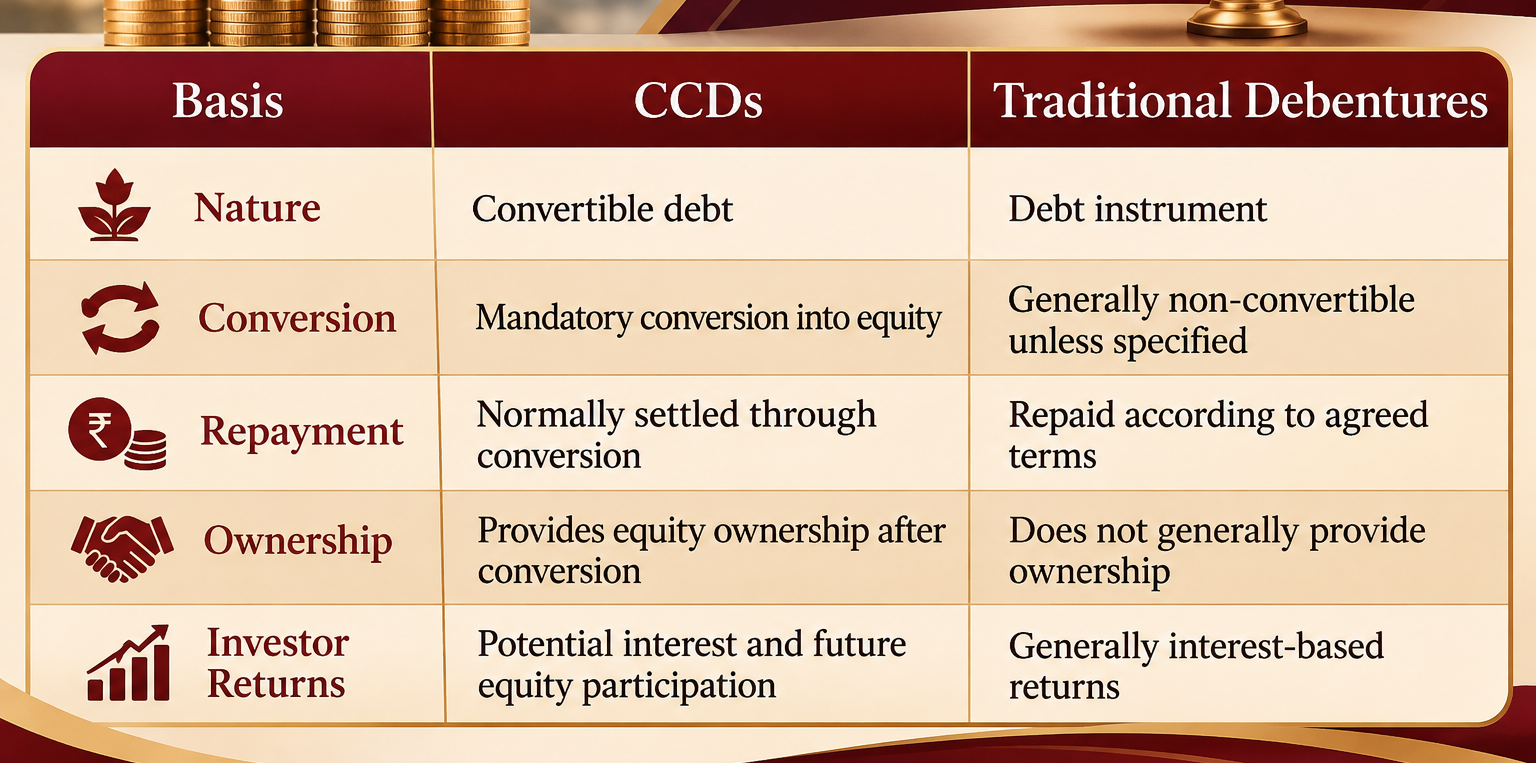
The choice between these instruments depends on the company's funding requirements, financial strategy, and investor expectations.
7. Risks and Important Considerations Before Investing in CCDs
Although CCDs offer several advantages, investors and businesses should carefully evaluate their potential risks.
Business Performance Risk: If the company does not achieve its expected growth, the value of the equity received after conversion may be lower than anticipated.
Valuation Risk: The conversion price and valuation methodology can significantly influence the investor's eventual ownership percentage.
Liquidity Risk: CCDs may not offer an easy exit before conversion. Investors should understand the transfer restrictions and exit provisions.
Dilution Risk: Existing shareholders may experience ownership dilution when CCDs convert into equity shares.
Regulatory Compliance: CCD issuance must comply with applicable corporate laws, securities regulations, foreign investment rules, and other relevant requirements, depending on the transaction.
Before entering into a CCD arrangement, both parties should carefully review the investment agreement, conversion conditions, financial projections, and associated legal obligations.
8. The Role of CCDs in Strategic Investment Planning
Modern businesses require flexible financial structures to support expansion and long-term development. CCDs can play an important role in strategic investment planning by connecting immediate funding requirements with future equity participation.
For investors, understanding the company's business model, financial health, management capabilities, and growth potential is essential before committing capital.
For companies, selecting the appropriate funding structure requires balancing capital requirements, ownership considerations, and future financial obligations.
At Pangea Stellar, we believe that informed investment decisions begin with understanding the opportunity, evaluating the financial structure, and identifying the factors that can influence long-term value. A well-planned investment approach can help businesses and investors navigate opportunities with greater clarity.
Frequently Asked Questions (FAQs)
1. What are Compulsorily Convertible Debentures (CCDs)?
CCDs are financial instruments that initially function as debt but must be converted into equity shares after a predetermined period or when specified conditions are met.
2. How are CCDs different from ordinary debentures?
Ordinary non-convertible debentures are generally repaid according to their agreed terms, whereas CCDs are mandatorily converted into equity shares instead of being repaid as conventional debt.
3. Do CCD investors receive interest?
CCDs may carry an interest component depending on the terms of issuance. The applicable interest rate and payment conditions should be clearly mentioned in the investment agreement.
4. What happens after CCDs are converted into equity shares?
After conversion, investors become shareholders of the issuing company and receive ownership rights according to the shares allotted and their applicable class of shares.
5. Are CCDs a suitable investment option?
CCDs may be suitable for investors seeking potential long-term equity participation. However, their suitability depends on the company's financial health, valuation, conversion terms, risk profile, and the investor's financial objectives.
Conclusion
Compulsorily Convertible Debentures offer a structured approach to business fundraising by combining an initial debt arrangement with mandatory future equity conversion. They can help companies secure growth capital while providing investors with an opportunity to participate in future business performance.
However, their suitability depends on several factors, including business fundamentals, valuation, conversion terms, regulatory requirements, and investment objectives.
Understanding these elements before agreeing is essential for making informed financial decisions. Pangea Stellar brings together a exclusive portfolio of premium investment opportunities across diverse sectors. Explore our exclusive opportunities, discover emerging prospects, and find the right investment to align with your business and financial objectives. With more opportunities available, there is always something new to explore.
General information only. This article is not an offer, investment recommendation or substitute for independent professional advice.