


Pangea Stellar · 12 November 2026 · 9 min read
Restaurant investments can take different forms, depending on how a business is owned, managed and financed. Before committing money to the food and beverage sector, investors need to understand the structure of an opportunity and the factors that may influence its financial performance.
Company-level and outlet-level investment represent two distinct approaches to participating in the restaurant industry. One involves investing in the business entity behind a restaurant brand, while the other concentrates on an individual restaurant location or operating unit.
Understanding company-level vs. outlet-level investment helps investors compare ownership arrangements, capital requirements, management responsibilities and potential financial outcomes. It also highlights why a business opportunity should be evaluated on its underlying financial position rather than its brand reputation alone.
This article examines both investment models, their potential advantages, associated risks and the considerations that can help investors make informed decisions in India's restaurant and hospitality sector.
Understanding Company-Level Investment
Company-level investment involves providing capital to a business entity in exchange for an agreed financial interest. Depending on the legal arrangement, this may involve purchasing equity, acquiring shares or participating through another investment structure.
In the restaurant industry, a company may operate several outlets, develop new concepts, establish supply chains and enter additional markets. Funding at this level can support activities such as expansion planning, technology upgrades, brand development and improvements to central operations.
Consider a restaurant business that operates locations in several cities. An investor participating at the company level may gain exposure to the organisation's overall financial performance, subject to the ownership structure and investment agreement.
The potential benefit is linked to the business as a whole, not automatically to the performance of every individual outlet. Investors should examine the company's financial statements, outstanding liabilities, governance arrangements and expansion plans before deciding whether the opportunity suits their objectives.
Understanding Outlet-Level Investment
Outlet-level investment directs capital towards a particular restaurant location or operating unit. The funds may cover expenses such as property deposits, kitchen equipment, interior development, licences, initial inventory and working capital.
The investment arrangement can vary. Some opportunities involve direct ownership or a partnership, while others operate through franchise agreements or alternative contractual structures. These arrangements may provide different levels of control, financial participation and responsibility.
For example, an investor considering a restaurant in a busy commercial district would need to assess expected customer demand, rent, staffing expenses, local competition and projected sales. These factors help determine whether the proposed location has a commercially viable operating model.
Unlike a company-level investment, which may depend on the performance of a wider organisation, an outlet-focused arrangement places greater emphasis on the selected location. However, its financial outcome still depends on market conditions, management quality and the terms agreed between the parties.
Company-Level vs. Outlet-Level Investment: Key Differences
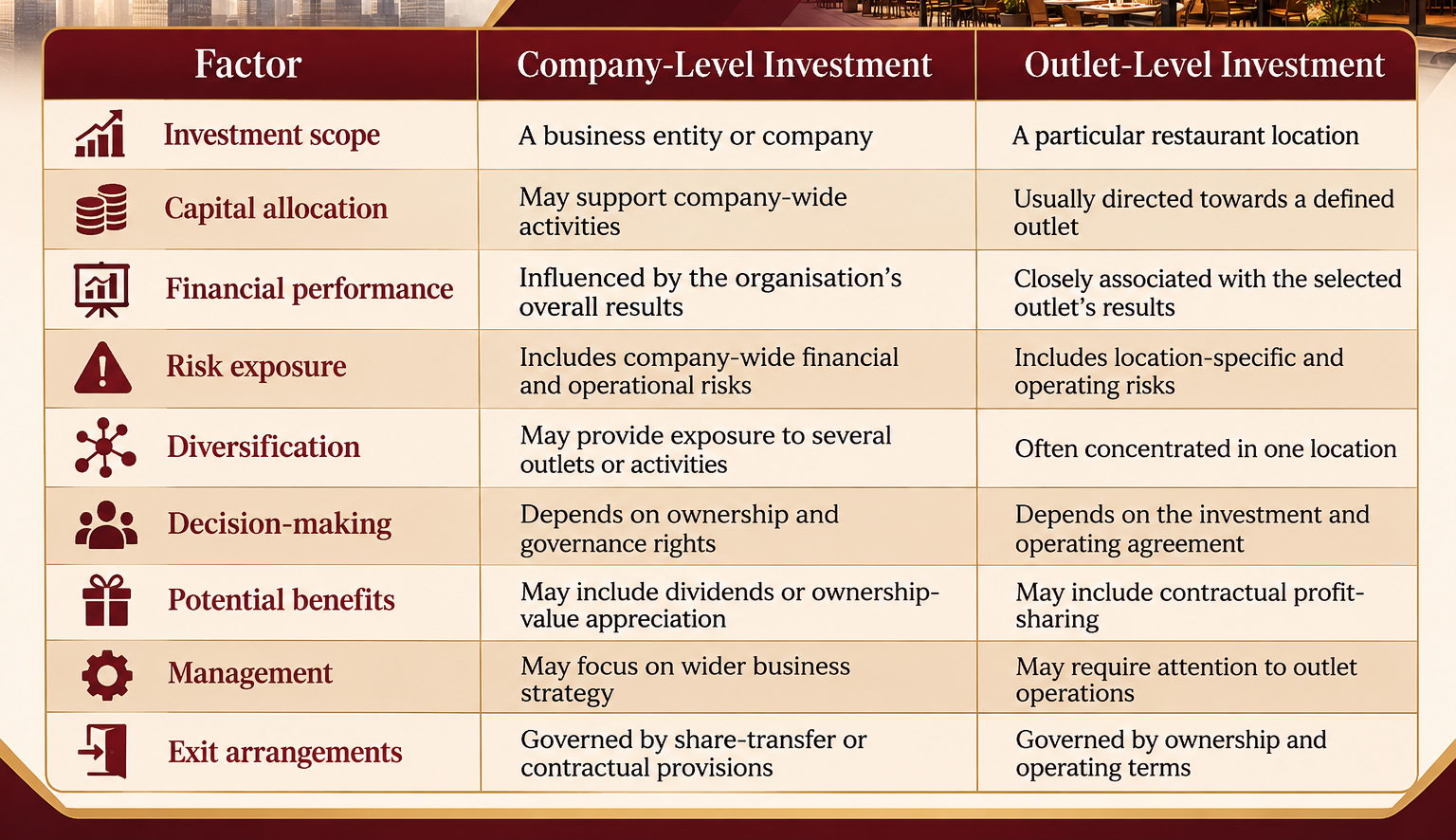
Neither structure automatically delivers better results. A company with several locations can experience financial difficulties, while a single restaurant may perform well if its costs, customer demand and operations are managed effectively.
Benefits of Company-Level Investment
1. Participation in Wider Business Growth
Funding at the company level may help a restaurant business introduce new concepts, enter additional markets or improve its operating infrastructure. If these initiatives perform well, they may contribute to stronger business performance and long-term value creation.
2. Exposure to Multiple Business Activities
An established restaurant company may generate business through several locations, brands or revenue channels. This can reduce dependence on a single outlet, although common challenges such as rising ingredient prices or declining consumer spending may still affect the wider organisation.
3. Access to Strategic Information
Depending on the agreement, investors may receive financial reports, voting rights or other governance-related benefits. Such information can help them assess the company's direction, use of capital and progress against business objectives.
4. Potential for Long-Term Value Appreciation
A company may become more valuable as its brand recognition, operating efficiency and market presence develop. Investors with appropriate ownership rights may benefit from this increase in value. However, valuation growth is not guaranteed, and investors may lose part or all of their invested capital.
Benefits of Outlet-Level Investment
1. A Clearly Defined Business Opportunity
An individual restaurant provides a specific location and operating model to evaluate. Investors can examine the property's suitability, expected footfall, rent, menu pricing and estimated sales before assessing the financial projections.
2. Greater Visibility into Operating Performance
Outlet-level reporting can help identify how revenue and expenses change over time. Measures such as food costs, staffing expenses, average transaction value and operating margins provide useful information about the location's performance.
3. A More Specific Capital Plan
An outlet-focused proposal may provide a breakdown of establishment expenses, equipment requirements, deposits and working capital. This helps investors understand the planned use of their money, although actual costs can exceed initial estimates.
4. Opportunities to Improve Business Efficiency
Monitoring sales and operating expenses can reveal opportunities to reduce wastage, improve staffing arrangements and strengthen customer retention. These measures may support profitability, but their effectiveness depends on implementation and local demand.
An Operational Example: Juno's Pizza
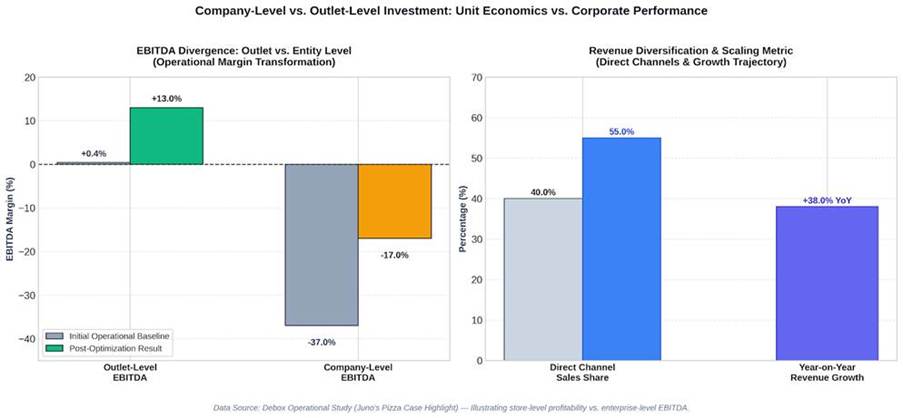
A published case study by Debox describes its work with Juno's Pizza in Mumbai between March and November 2018. The project focused on improving financial visibility across individual restaurant stores through sales analysis, store-level profit-and-loss reporting and stronger operational controls.
According to the published case study, outlet-level EBITDA increased from 0.4% to 13%, while company-level EBITDA improved from -37% to -17%. Sales through the company's own channels rose from 40% to 55%. The case study also reported year-on-year growth of 38% during the 2018–19 financial year.
Source: Debox — Juno's Pizza Outlet Profitability Case Study.
These reported figures illustrate the importance of understanding financial performance at both the store and company levels. The outlet-level measure improved substantially, but the company-level EBITDA remained negative at -17%.
This example concerns operational performance rather than a documented individual's investment return. The figures are reported in the published case study and have not been independently audited here. They should not be interpreted as typical outcomes or as evidence that another investor would achieve similar results.
Risks Associated with Both Investment Models
Restaurant investments require careful evaluation because financial performance can be affected by economic conditions, customer preferences, operating expenses and management decisions.
Company-Level Investment Risks
An investor at the company level is exposed to the organisation's broader financial position and strategic choices. Expansion that requires excessive capital, increasing debt, weak management or declining demand can affect several business activities at once.
Investors with limited voting rights may also have little influence over important decisions. In addition, selling an ownership interest may be difficult if the agreement restricts transfers or there is no suitable buyer.
Outlet-Level Investment Risks
An individual restaurant can be affected by expensive rent, limited customer footfall, local competition, staff turnover and fluctuations in food prices. These pressures can reduce operating margins even when the brand is familiar to customers.
A location may also take longer than expected to reach break-even. Investors should therefore evaluate conservative sales estimates, recurring expenses, working-capital requirements and the possibility of additional funding before entering an agreement.
Capital Requirements and Potential Returns
The amount of capital required depends on the investment structure and the specific opportunity. At the company level, funding may be determined by business valuation, the ownership percentage being offered and the company's financing requirements.
At the outlet level, the assessment typically includes property deposits, fit-out expenses, equipment, licences, inventory and funds needed to support early operations.
Investors should also understand the financial measures used in a proposal. Revenue represents sales, whereas operating profit accounts for relevant operating expenses. Net profit includes additional items, and cash distributions depend on the company's financial position and the agreement.
A projected return should not be treated as a guaranteed outcome. Before investing, individuals should review the assumptions behind sales forecasts, cost estimates, break-even calculations and the expected time needed to recover their capital.
How to Evaluate the Right Investment Approach
Choosing between company-level and outlet-level investment requires an assessment of personal objectives, available capital and acceptable risk.
Company-level opportunities may suit investors who want exposure to a wider organisation and are comfortable evaluating company financials, governance rights and expansion plans.
Outlet-level opportunities may appeal to those who prefer to assess a particular location, understand its cost structure and examine its operating projections in detail.
Before making a decision, investors should:
• Establish their financial objectives and risk tolerance.
· Review the legal structure and rights attached to the investment.
· Examine financial statements and realistic sales projections.
· Understand management responsibilities and reporting arrangements.
· Check exit provisions, liquidity restrictions and additional funding obligations.
· Seek independent legal, tax and financial advice when necessary.
Due diligence should cover both the opportunity being presented and the people responsible for managing it. Clear documentation and realistic assumptions are essential for evaluating potential benefits and limitations.
Frequently Asked Questions
1. What distinguishes company-level investment from outlet-level investment?
Company-level investment involves an interest in a business entity, while outlet-level investment focuses on an individual restaurant location or operating unit. The investor's rights and financial benefits depend on the relevant agreement.
2. Which investment structure carries less risk?
Neither structure is inherently less risky. Company-level investment may spread exposure across several activities, while outlet-level investment may concentrate it in one location. Financial health, management, market conditions and contractual terms influence the actual risk.
3. How much capital is needed to invest in a restaurant?
There is no universal amount. Company-level funding depends on valuation and ownership terms, while outlet-level funding depends on establishment expenses, location and working-capital requirements. Each opportunity needs an individual financial assessment.
4. How should potential investment returns be assessed?
Investors should examine financial statements, cash-flow projections, operating expenses and break-even estimates. They should distinguish historical results from forecasts and understand which costs are included in any quoted return.
5. What should investors know about exit options?
Exit arrangements depend on the legal structure and investment agreement. Share transfers, buybacks or sales of an ownership interest may be possible in some arrangements, subject to applicable restrictions and conditions.
Conclusion
Company-level and outlet-level investment provide different ways to participate in the restaurant industry. The first centres on the wider business entity, while the second focuses on a particular operating location.
Each approach has potential advantages, but financial outcomes depend on the underlying business, management quality, market conditions and contractual rights. Reviewing financial information, testing business assumptions and understanding exit arrangements can help investors make better-informed decisions.
A careful assessment of company-level vs. outlet-level investment allows individuals to compare opportunities more clearly and identify the structure that aligns with their objectives and risk tolerance.
General information only. This article is not an offer, investment recommendation or substitute for independent professional advice.